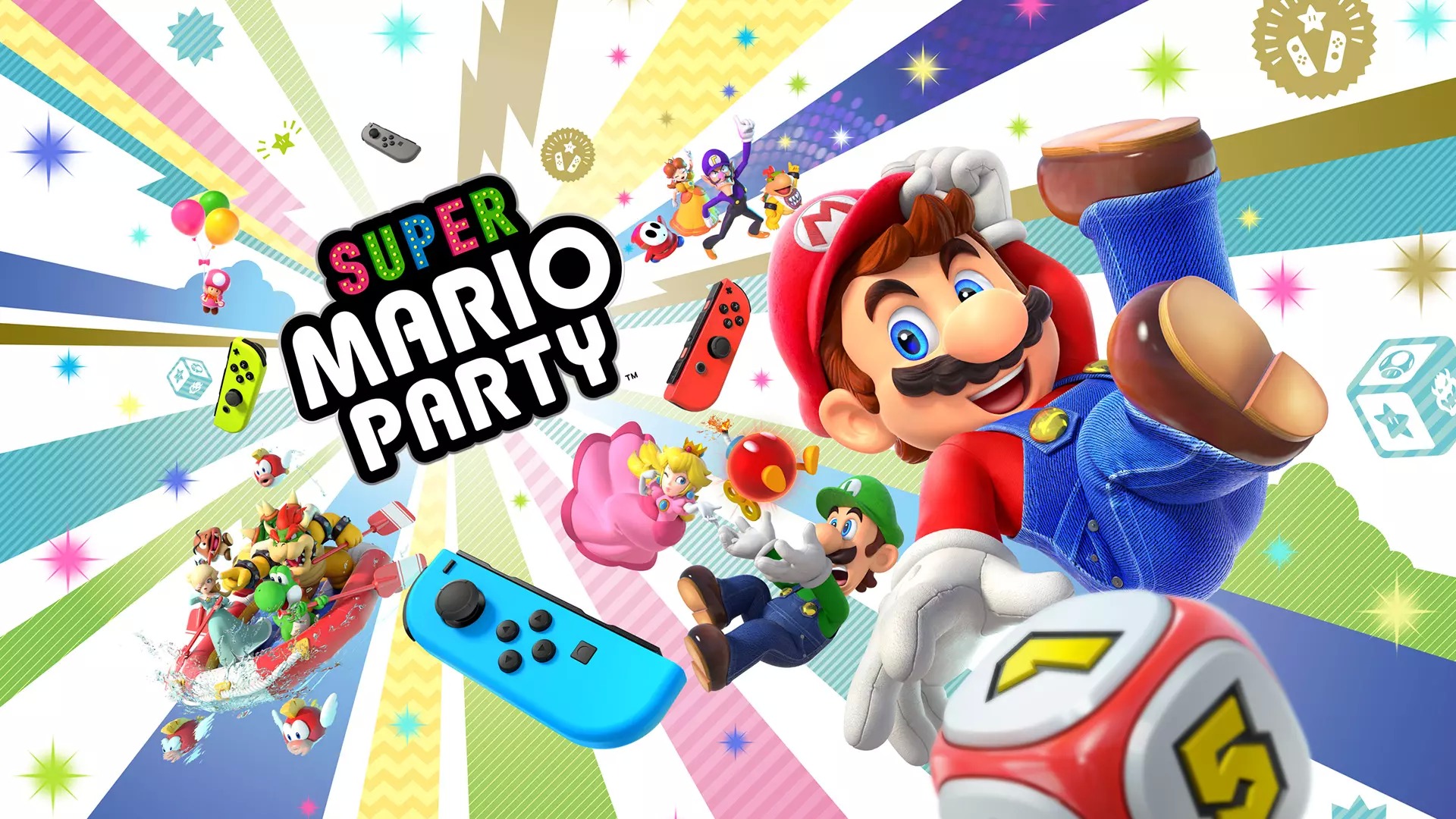
 Super Mario Party, a board-video-game that now comes with about 100% less car. It came out yesterday for us mortals who don’t get review copies (please sponsor me Nintendo), but how does it hold up? Is it as good as ye olde GameCube games, or is it Mario Party 10 but without the car? Let’s find out.
So, as is evidenced by the fact that it is merely one day after release, I haven’t had a whole lot of time to play the newest iteration of Nintendo’s beloved friendship-destroyer. However, the little time I have had, including a crack at each of the game’s main modes aside from Toad’s Rec Room, showed me clearly where the game shines, and where it needs a bit more polish. Starting from the very beginning, the first thing when you boot up the game (aside from the obligatory load screen) is a menu asking how many human players will play the game, with a maximum of four. After setting this up (alongside the number of consoles), we are greeted with a short, but delightful opening cutscene. The game’s opening is just like most others in the series: Mario and the gang want to find out who the Super Star is, and Toad and Toadette have the great idea of hosting a Mario Party to determine just that. However, in classic Nintendo fashion, Bowser and his Koopa Pack, er, troops, want in on the action, offering up Kamek as another judge to the party. And thus, the party begins! After a few more basic preparations, such as choosing characters and difficulty, you are free to party! From the get-go, most of the modes in the game are already unlocked. But to get to these modes, you have to traverse the (rather small) hub world to find them. You can also interact with the three judges, and various Mario characters (including those you didn’t choose to play as) around the “Party Plaza.” Of most interest are Toad, Toadette, Birdo, and secret characters, but I’ll get back to that in a moment. For now, let’s move on to the rest of the tutorial.
After entering the main part of the plaza (which houses the classic Mario Party mode, as well as the new River Survival and Sound Stage modes), Toad (who’s lookin’ downright spiffy with his new bowtie that crimps Luigi’s style from Odyssey) pulls you into another cutscene to give you the Party (Game)Pad. This is essentially fast travel, alongside some helpful articles for newer players, a sound test, stickers like in the Ultra Pokemon games’ photo studio, and a chart of the Gems you have acquired. You obtain these Gems from playing through the content in specific modes of the game, with only Minigame (Free Play), Mariothon, and Toad’s Rec Room neglecting to give Gems for completion. While completing modes, especially the minigame-oriented Challenge Road, you can also unlock the four secret characters, who appear in the back area of the Plaza. Regarding the other important characters you can talk to in the Plaza, Toad will update your Pad so you can buy more Stickers for the photo mode or music if you buy said Stickers and music with each update, Toadette will put you on track for one of the Gems you’re missing, and Birdo will give you small quizzes in return for rewards like Stickers or the Gold Oar for River Survival. Speaking of which…
The modes. As I eluded to, there is a nice variety of new and old modes. The traditional board game is found under Mario Party, whereas a two v. two team mode, with a style similar to Star Rush, is Partner Party. Aside from main modes, there’s also the four-player co-op River Survival, which has you drifting down a treacherous river while playing minigames, and the Rhythm Heaven-esque Sound Stage, with what is literally just Cheer Readers, and what appears to be an homage to Fillbots as minigames. Alongside those, there is a Minigame Free Play mode where you can play specific ones to your heart’s content, or if you’re looking for more of a challenge, Challenge Road is a compilation of all 80 games, but competitive rather than free play. Online Mariothon is the mode that should’ve been online Mario Party, but instead is just 10 minigames that can be played in groupings of 5 online with up to three other players. As for the two pipes (which open up after playing one round of Mario Party), one leads to the Sticker studio, and the other to Toad’s Rec Room, with a few novelty minigames that can use two consoles. And now finally, let’s talk about…
The gameplay. To those of you who read everything else, thank you and sorry for writing so much exposition. Now that we’re here, let’s discuss each mode on its own. Starting with: Mario Party. The classic mode you know and love is back in (mostly) full force, however there are a few changes, as is what happens with each iteration of the series. First of all, since both Bowser and DK are playable, we instead have Lucky and (Extra) Bad Luck spaces. Additionally, this game sees the return of Hidden Blocks, as well as a bunch of new items. However, the biggest new feature is the addition of character specific Dice Blocks. Alongside this is the newly revamped Ally mechanic (from Star Rush, again), with subsequent Ally Spaces, where you can pick up another character’s special Block alongside a little bit extra in your roll each turn. As for how this affects gameplay, it really adds another layer to the strategy of the game in whether or not it is smart to use your character’s Dice Block for an advantage. Plus, characters like Bowser, Wario, Waluigi, and others have high-risk, high-reward dies that can either send you far ahead of the pack or make you lose coins and move 0 spaces. As for Partner Party, it’s Toad Scramble but with altered mechanics, such as the fact that there are Star Spaces instead of bosses, specific board gimmicks, and different items. I’m now going to shift gear and talk about the new modes.
River Survival. An odd mode that’s way more satisfying than it should be. Quite simply, you raft down a river attempting to get to the end by playing minigames to gain time so you can get to the end. You utilize the Joy-Con as a paddle to row your way to the end, which is one of many ways the controller is used well. And finally, Sound Stage sees you using the ‘Con to make all sorts of odd motions to play a Rhythm Heaven styled minigame. Although the Joy-Con’s motion controls are usually despised, they work surprisingly well here, with minimal hiccups.
So, let’s wrap up this review/ me spouting random explanations of the game. Lots of people are debating whether or not to purchase the game, and there are good reasons on both sides. For example, people are saying that the Joy-Con controls are off and there isn’t enough content. However, the controls aren’t that bad, but the lack of content is a concern. Although there should’ve been more boards, what we got was a great Mario Party game that is fun to play and will likely get the Mario Tennis Aces treatment with free DLC boards and characters. If you’re looking for a good multiplayer Switch game that isn’t Hyrule Warriors or Kirby: Star Allies, this is a good one to pick up.

 Okay, so first off, credit where credit is due to the creator of this list. However, that does not excuse their list from criticisms, so here are some of my own: Goomba and Monty Mole have some of the least unique and helpful dice in the game, yet Goomba is B-tier? Nope. And having Shy Guy and Diddy as low/mid-tiers is a clear mistake, as Shy Guy is better than Daisy at her own job and Diddy is just a higher risk-reward version of Dry Bones. Also, putting Hammer Bro as bottom tier while Mario is mid-tier? No way, Mario is just the normal die but with 3s instead of a 2 and 4. Everything else is decently okay, except maybe Koopa because he can pretty much guarantee a low roll.
 Smash Ultimate. Yeah. It’s a pretty dang cool game. I should know, as I somehow managed to play it after waiting for five hours in Torrance for the demo. A major factor of its coolness is the fact that so many fan requested characters are in the game, like Ridley, Chrom, K. Rool, etc. Because of this, many people have speculated on all sorts of new characters, including (prominently) a Gen 7 Pokemon, Bandana Waddle Dee, Skull Kid, Geno, Banjo-Kazooie, Isaac, Shantae, and Chorus Kids/Karate Joe. Today, however, I’m gonna grasp at straws and tell you why I believe that Crono from Chrono Trigger will be in the game in some form. As I said in the disclaimer, this is my opinion and I am in no way a leaker. I’m just trying to explain why I believe Crono will be in the game or represented in some way. To be specific, I’m gonna explain why I think that the Nintendo Direct we had on the 13th points more towards Crono than Geno’s inclusion (alongside other evidence), as Geno is basically a sure bet at this point.
 Here’s where my very opinionated logic comes in. As I have already mentioned, there was quite the Square feature with Final Fantasy in the Direct. However, there were other small details that could reference potential newcomers. Mainly, Kirby’s EXTRA Epic Yarn for BWD/a spinoff Dream Friend update for Star Allies, Splatoon 2 Anime, er, Version 4.0 for Octolings, XC2 Torna for Rex and Pyra/Mythra, TWEWY for Sora (Ok, that one was a joke), and the Square-case for Crono. Now, that might seem like a loose comparison looser than saying, “Well, Cloud and Crono have the same anime-lookin’ haircut,” but I implore you to delve a bit deeper. Drawing from the YouTuber Alpharad’s vaguely joke-oriented idea that the K. Rool reveal referenced Dragon Ball, consider this: Akira Toriyama (creator of said series) worked on Chrono Trigger as a character (and PS1 cutscene) designer. Who else have fans been enamoring for in Smash? Goku. Okay, so that prediction was a bit out there, but I have other reasons why I think Crono will make an appearance. Looking more in-depth into the showcase itself, let’s try to draw another comparison to Chrono Trigger. Which just so happens to come near the end of it. Final Fantasy 12: The Zodiac Age has a battle system all too similar to a certain SNES classic. And, there has been a bit of buzz around the game rather recently with its wildly underwhelming port to Steam.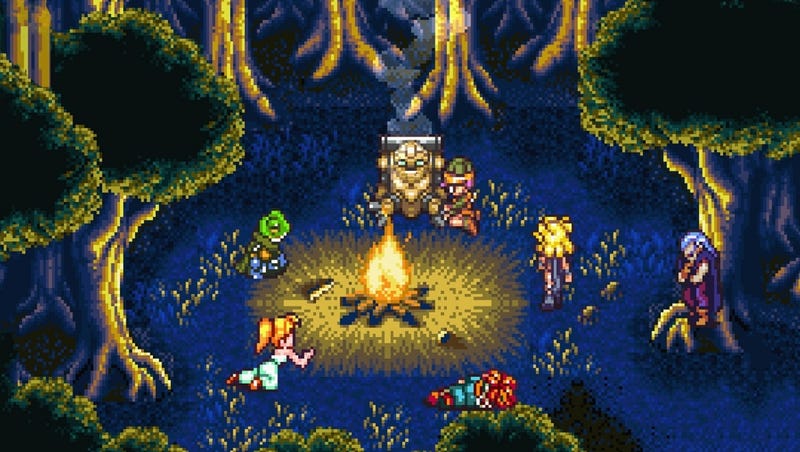
 However, even with so much evidence to the contrary, I still believe in Crono’s chances. He could even be the mythical Cloud echo fighter that many a person speaks of. Consider how his moveset could differ from our favorite annoying top-tier with a sword. His up-special Climhazzard could quite easily be replaced with Cyclone, in a move similar to Spin Slash (and possibly turning Cyclone into his down smash). And since we know that Crono’s element is Lightning, that could very easily transfer from Pikachu’s down-special. Finally, for a replacement of Cross Slash he could have Confuse, or “Frenzy” as it is known in the re-releases. And as for Blade Beam, it is quite literally a glorified version of Slash, but perhaps it couldn’t be reflected or pocketed. Aerials are easy to fix, perhaps giving him a neutral similar to Pikachu’s new setup to reference Luminaire. And as far as Final Smashes go, with a new emphasis on the cinematic, he could bring those he captures with a Gate to the moment of his “death” by Lavos near the Mammon Machine. Or possibly even Triple Raid, in a fashion not dissimilar to Shulk. His moveset would be super interesting and turn an overly toxic character into something more varied and definitely fun to play. And hey, even if he ends up as an assist trophy or omitted from the game entirely, I can still imagine what he would play like. My bet is that his kit would be more trap-central, taking into account Lightning when you go offstage to set up traps and maybe even using Slash effectively. Since this is kinda my “perfect dream” for an out-of-the-blue character, I won’t be overly salty if Crono doesn’t manage to make it in (looking at you, rabid Waluigi fans). In any case, thank you, dear reader, for listening to what I have to say regarding the new Smash game and my wacky predictions. Come back once in a while to see what sort of inane theory I present in the next post. So until said post, goodbye, and have a wonderful day. And hey, there’s always hope for the Fighters Pass…

 MegAlex's Nintendo Blog